


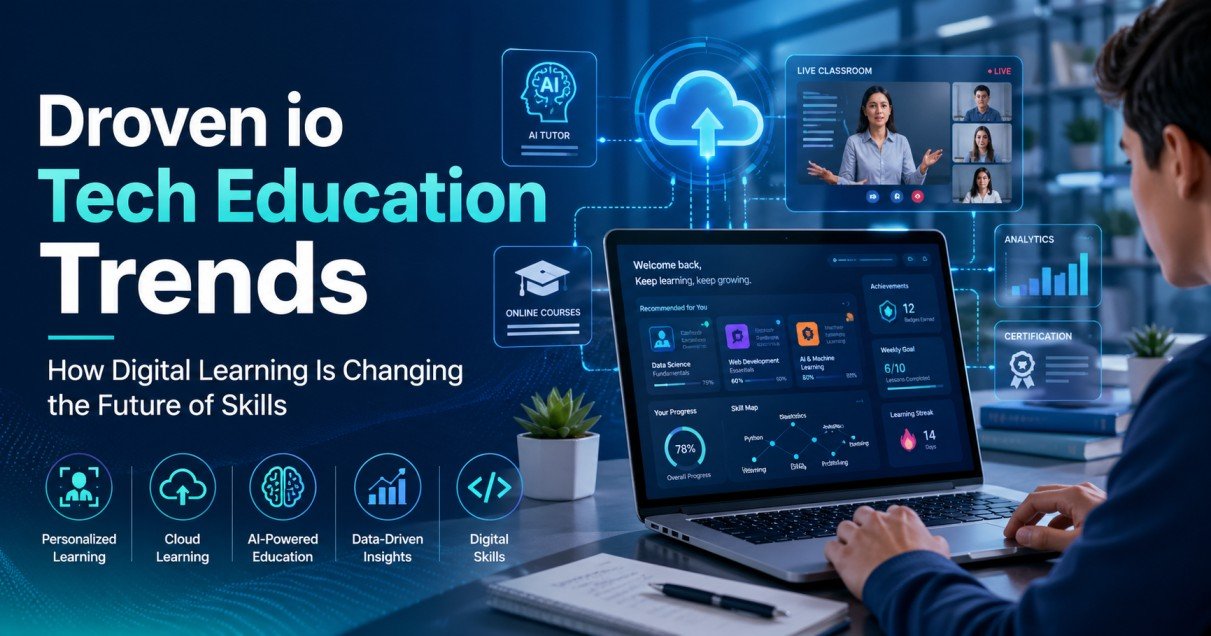
Droven io tech education trends show how fast education is moving from traditional classrooms to smarter, more flexible, and skill-based learning. Today, students are not only reading textbooks or attending lectures. They are learning through artificial intelligence, online platforms, cloud tools, virtual labs, coding environments, and short career-focused courses. This change is not just about using modern devices in classrooms. It is about preparing learners for a world where digital skills, problem-solving, adaptability, and lifelong learning matter more than ever.
Education technology has become a serious topic because the job market is changing quickly. The World Economic Forum’s Future of Jobs Report 2025 highlights that AI, big data, cybersecurity, networks, and technology literacy are among the fastest-growing skill areas for the coming years. That means schools, colleges, training platforms, and learners must think beyond old learning methods and focus on practical knowledge that connects directly with real-world work.
Table of Contents
The Rise of AI in Education
One of the strongest parts of droven io tech education trends is the growth of artificial intelligence in learning. AI is helping students understand lessons in a more personal way. Instead of giving the same material to every learner, AI tools can adjust explanations, practice questions, and feedback according to each student’s level.
For example, a student struggling with mathematics can receive easier explanations and extra practice, while an advanced student can move toward more challenging tasks. Teachers can also use AI to check assignments, identify weak areas, and save time on repetitive work. This does not mean AI replaces teachers. A good teacher still provides guidance, emotional support, discipline, and real human understanding. AI works best when it supports teaching, not when it removes the human role.
UNESCO also notes that artificial intelligence can improve teaching, learning, and assessment, but it must be used carefully because fast technology growth also brings risks around ethics, privacy, and regulation.
Personalized Learning Is Becoming Normal
Traditional classrooms often move at one speed. Some students understand quickly, while others need more time. Personalized learning solves this problem by giving each learner a more suitable path. This is one reason droven io tech education trends are important for modern education.
Personalized learning can include adaptive quizzes, recommended videos, digital progress reports, and learning dashboards. These tools help students see where they are strong and where they need improvement. For teachers, this creates a clearer picture of class performance. Instead of guessing who needs help, teachers can use data to support students more accurately.
However, personalized learning should not become fully automatic. Education is not only about completing modules. It is also about asking questions, building confidence, developing communication skills, and learning from mistakes. The best digital education systems combine smart technology with strong teaching methods.
Online and Hybrid Learning Are Here to Stay
Online learning became more common during global school closures, but it did not disappear afterward. Many students, professionals, and institutions now prefer a mix of online and offline education. This hybrid model is flexible, affordable, and easier to access.
A learner can attend a live class from home, watch a recorded lecture later, submit assignments online, and still join physical workshops when needed. For working professionals, this model is especially useful because they can learn new skills without leaving their jobs. For students in remote areas, online learning can provide access to teachers, courses, and resources that may not be available locally.
This trend is a major part of droven io tech education trends because it shows that learning is no longer limited to a physical classroom. A mobile phone, laptop, or basic internet connection can open the door to high-quality learning when the platform is well designed.
Skill-Based Learning Is More Important Than Theory Alone
Modern employers want people who can do real work, not just pass exams. This is why skill-based education is growing quickly. Students are now focusing on coding, digital marketing, cybersecurity, AI tools, data analysis, design, communication, and project management.
Theory still matters, but it becomes more useful when connected with practical tasks. For example, learning programming is stronger when students build small apps. Learning cybersecurity is better when students practice in safe lab environments. Learning digital marketing becomes clearer when students work on real campaigns, analytics, and content planning.
The World Economic Forum has emphasized that technological skills are expected to grow rapidly in importance, while curiosity, lifelong learning, resilience, and creative thinking are also becoming valuable. This confirms that future-ready education must develop both technical and human skills.
Microlearning Fits the Modern Student
Another important part of droven io tech education trends is microlearning. This means learning through short, focused lessons. Instead of sitting through long lectures, learners can complete small learning units in a few minutes.
Microlearning works well for busy students and professionals. A person can learn one concept, watch one short tutorial, complete one quiz, or practice one skill during a break. This style is useful for topics like software tools, vocabulary, coding commands, marketing tips, safety training, and exam revision.
The benefit of microlearning is that it reduces pressure and makes learning feel manageable. But it should be organized properly. Random short videos are not enough. A strong microlearning system must connect small lessons into a clear learning path so students understand how each topic fits into the bigger picture.
Virtual Labs and Cloud-Based Practice
Technology education becomes powerful when students can practice. Cloud-based labs are making this possible. Students can now learn coding, networking, cloud computing, database management, and cybersecurity through online practice environments.
This is helpful because not every school can afford expensive computer labs or advanced equipment. With cloud labs, learners can access tools through a browser and practice from almost anywhere. A cybersecurity student can test safe simulations. A software student can run code online. A data student can work with sample datasets without installing heavy software.
This trend supports equal opportunity when internet access and device availability are handled properly. It also makes education more practical because students learn by doing instead of only watching.
Virtual Reality and Immersive Learning
Virtual reality and augmented reality are also shaping the future of education. These tools make learning more visual and interactive. A medical student can explore the human body in 3D. An engineering student can study machines virtually. A history student can experience a reconstructed historical site. A science student can observe experiments that may be difficult or unsafe in a normal classroom.
EDUCAUSE’s 2025 Horizon Report notes that AI and virtual reality are changing how students engage with content and how learning is understood and documented.
This does not mean every classroom needs expensive headsets immediately. The real value of immersive learning is in subjects where visual experience improves understanding. When used with purpose, it can make difficult topics easier and more memorable.
Data Privacy and Responsible Technology Use
Every discussion about droven io tech education trends should include responsibility. Digital learning platforms collect data about students, including progress, behavior, test results, and sometimes personal information. This can improve learning, but it also creates privacy concerns.
Schools and platforms must be careful about how they collect, store, and use student data. Parents, teachers, and learners should understand what information is being tracked and why. Technology should support education, not exploit students.
UNESCO’s technology in education report explains that technology can help with access, inclusion, quality, and system management, but it can also create problems when used without proper planning and safeguards.
Teachers Still Matter More Than Tools
A common mistake is thinking that technology alone can fix education. It cannot. A smart platform is useful, but a skilled teacher makes learning meaningful. Teachers understand emotions, motivation, classroom behavior, and cultural context in ways that machines cannot fully replace.
The role of teachers is changing, not disappearing. Teachers are becoming mentors, facilitators, content guides, and learning designers. They use technology to improve lessons, track progress, and support students more effectively. In the best classrooms, technology handles routine tasks while teachers focus on explanation, discussion, creativity, and personal support.
Career-Focused Certifications Are Growing
Short courses and certifications are now common because industries change faster than traditional degree programs. A person working in marketing may need to learn AI tools. A computer science student may need cloud certification. A business graduate may need data analytics skills.
This is why droven io tech education trends connect strongly with lifelong learning. Education is no longer something people finish once. Workers must continue updating their skills throughout their careers. The most successful learners will be those who can adapt, practice regularly, and stay open to new tools.
Read More Articles: The Unite Magazines
Conclusion
Droven io tech education trends reflect a major shift in how people learn, teach, and prepare for the future. AI, personalized learning, hybrid classrooms, microlearning, virtual labs, cloud tools, immersive technology, and career-focused certifications are changing education in practical ways. These trends are not just about modern gadgets. They are about making learning more flexible, useful, and connected to real-life skills.
At the same time, technology must be used wisely. Privacy, fairness, teacher training, and human guidance remain essential. The best future of education will not be fully digital or fully traditional. It will combine strong teachers, smart tools, practical skills, and responsible learning systems. For students, professionals, and institutions, understanding droven io tech education trends is a smart step toward staying prepared in a fast-changing world.
